Is reading in the dark bad for your eyes? Drops, light, pillow
For many of us, the evening is the only time for a book. Then in the morning our eyes sting, our neck is stiff, and we start to wonder whether reading in bed is doing us harm.
I gathered what eye doctors and studies say about it: whether reading in the dark damages your eyes, what helps with dry eyes, which light to choose and how to position yourself. No health promises: this is general information, not medical advice.
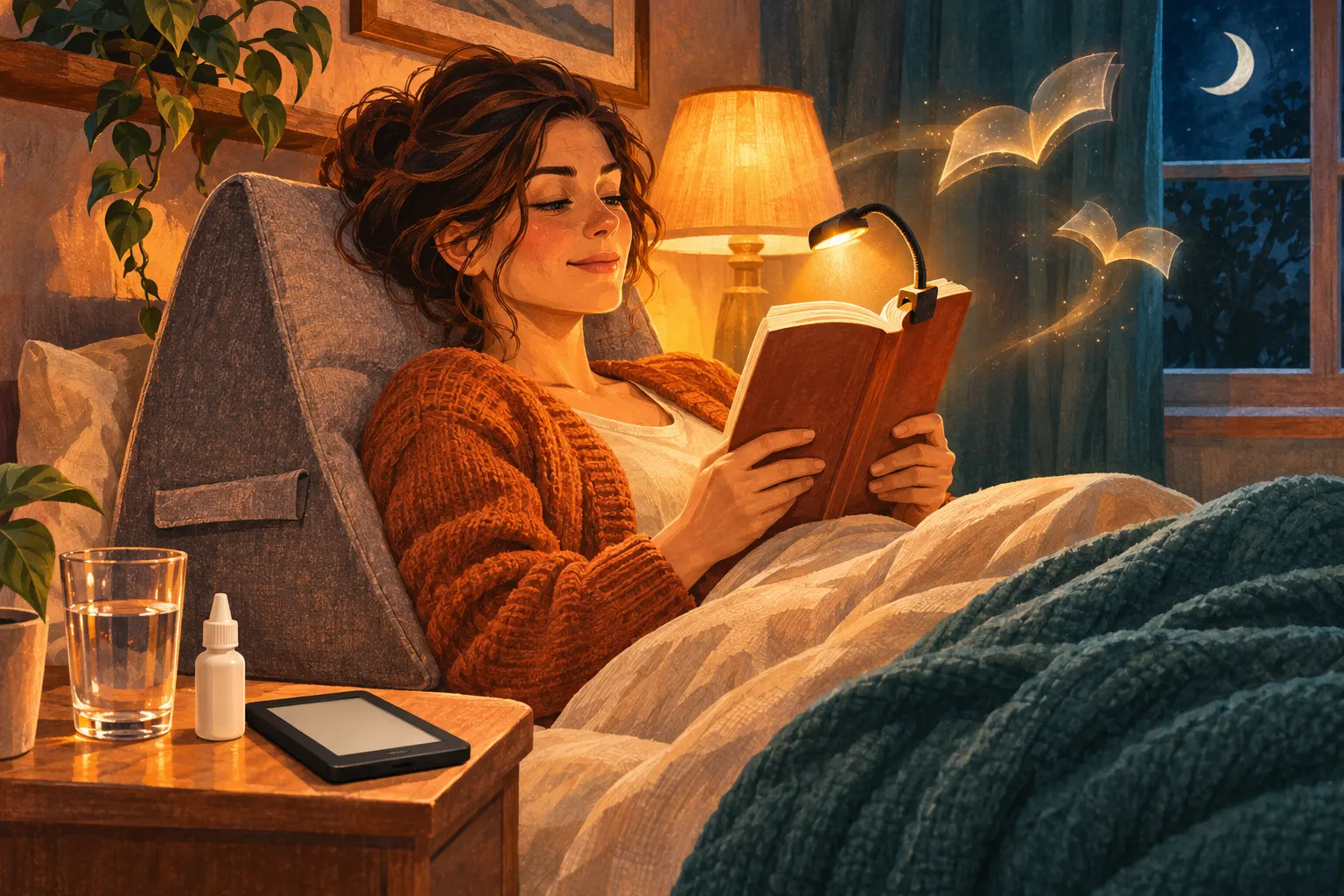
Amazon links in this article are affiliate links: if you buy something, we earn a small commission and your price stays the same.
In short: what helps when you read at night
For each situation, here's what helps most according to the sources and common sense. Some items lead to an Amazon search (these are affiliate links); the rest jump to sections further down.
- Eyes sting and feel gritty Eyes sting and feel grittyDropsartificial tears moisturise; preservative-free ones can be used more often
- You read in dim light You read in dim lightLightyour eyes tire faster when it's too dark
- Your neck hurts after an hour of reading Your neck hurts after an hour of readingWedgea head bent forward puts a heavy load on the neck
- You read for a long time without looking up You read for a long time without looking upBreakfocused eyes blink less and dry out
- You read on a tablet or phone You read on a tablet or phoneLighta bright screen before bed pushes back the time you fall asleep; a paper book with a warm lamp doesn't
Does reading in the dark damage your eyes?
No. The American Academy of Ophthalmology (AAO) lists it plainly as a myth: reading in dim light does not damage your eyes. It tires them faster, so you may get fatigue, stinging and a headache, but that goes away after a rest and leaves no lasting changes. The AAO says the same about reading a screen in a dark room and about lying on your side with a phone.
So where does the fatigue come from? When we focus, we blink less. The AAO gives about 15 blinks a minute in normal conditions and 5–7 at a computer screen. A 2014 study (25 people, the same text for 20 minutes on screen and on paper), however, found no difference in blink rate between screen and page. So blinking less comes from concentration, not from the screen itself: a paper book read late into the night dries your eyes too.
- Typical signs of eye strain: stinging, a gritty feeling, watering, blurred vision towards the end of reading, headache.
- What usually helps: more light on the page, breaks, lubricating drops, a shorter evening with a screen.
- Children: according to the AAO, all close-up work (books included) and little time outdoors contribute to short-sightedness, and time outside may slow it down. In observational studies the link between close-up work and short-sightedness is modest.
Which eye drops for tired eyes in the evening?
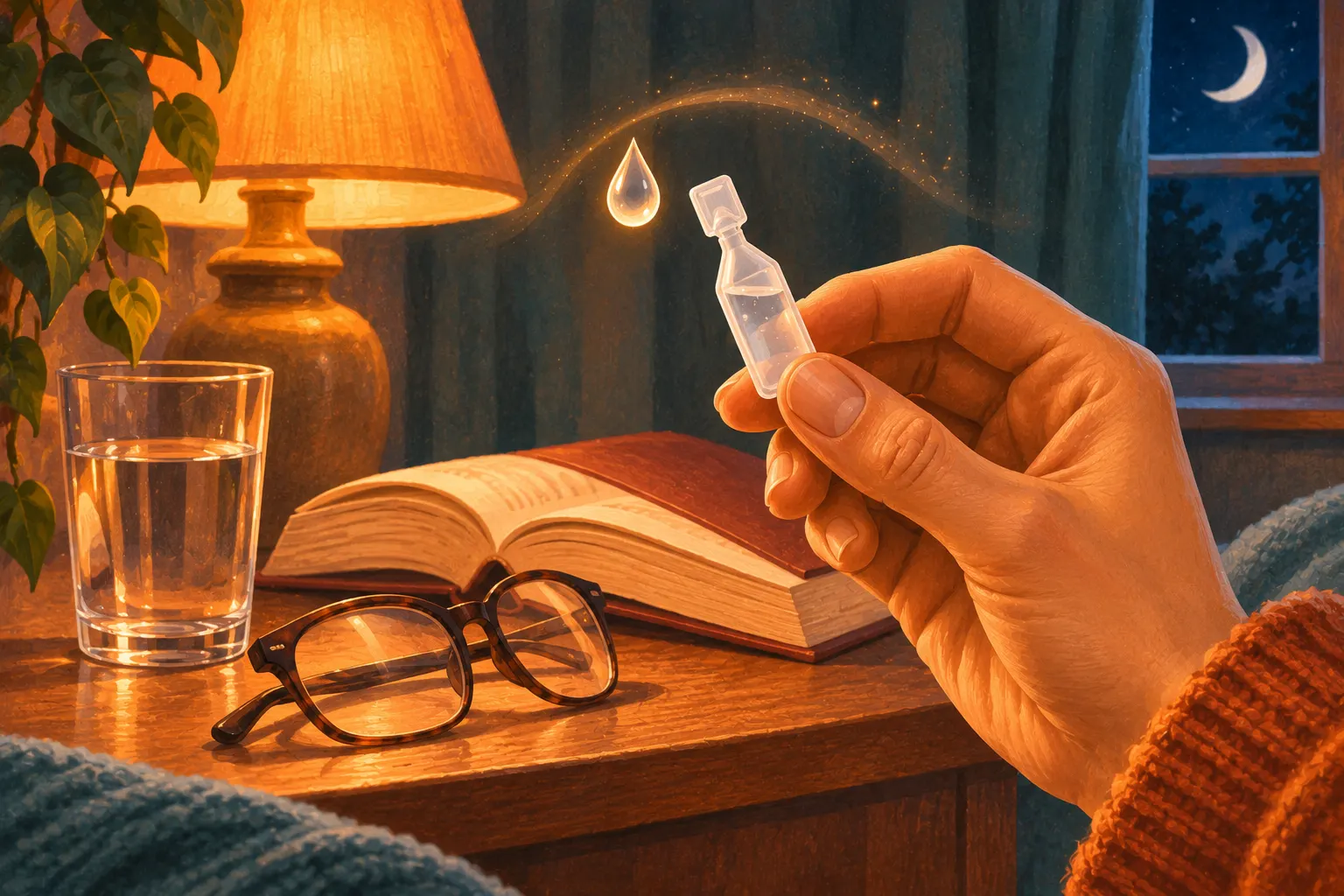
For dry, tired eyes, people use lubricating drops, also called artificial tears. A 2016 Cochrane review (43 studies) concluded that most of them work about equally well, although the evidence is of low quality. Hyaluronic acid comes out slightly ahead in some analyses, but the difference is small.
| Type | When | Watch out for |
|---|---|---|
| Preservative-free drops (often in single-use vials) | during the day and in the evening, as often as you need | once a vial is open, use it straight away or as the leaflet says |
| Drops with preservatives (bottle) | up to about 4 times a day | using them more often can irritate the eye |
| Eye gel or ointment | just before sleep | blurs your vision, so not for reading |
| “Redness relief” drops (they constrict blood vessels) | better avoided | the effect wears off and the redness can come back worse; the AAO advises against using them for more than 72 hours |
Wear contact lenses? Check the packaging to see whether the drops can be used with lenses, or ask a pharmacist. If your eyes are dry every day despite drops, it's worth seeing an eye doctor rather than just switching drops.
Eye breaks: the 20-20-20 rule
The AAO and Mayo Clinic recommend a simple rule: every 20 minutes, look at something 20 feet (about 6 metres) away for 20 seconds. A study that tested it (29 people, two weeks of reminders) showed fewer complaints, but the effect was gone a week after the reminders stopped. So it only works while you actually do it.
- At the end of a chapter, look up and gaze out of the window or across the room.
- Blink deliberately a few times, all the way, until your eyelids meet.
- If your eyes sting, take a break instead of reading “just one more chapter”.
What is the best light for reading in bed?
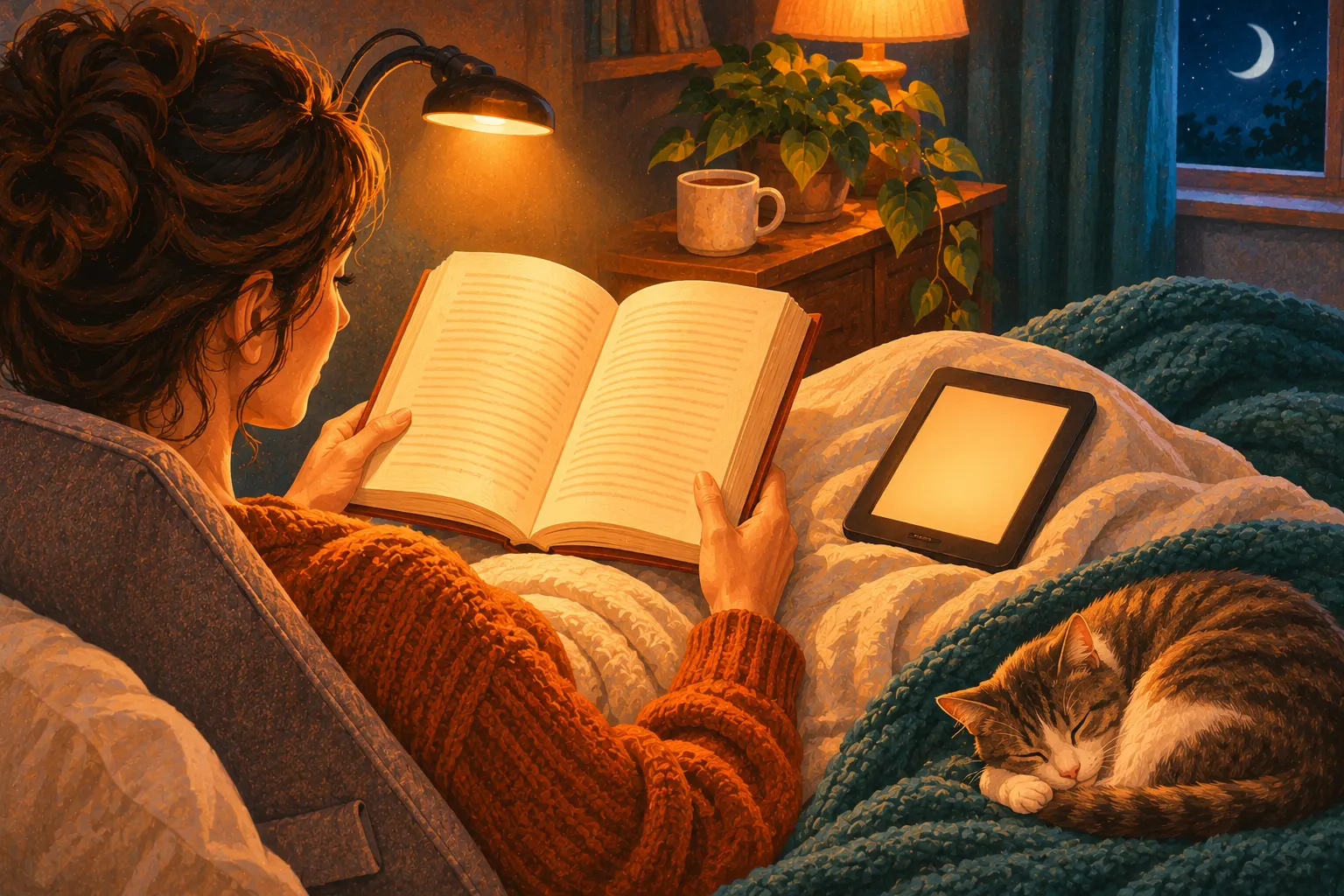
Mayo Clinic advises placing the light source behind you and aiming it at the page, not into your eyes. Glare on the page or screen strains your eyes too. For reading itself, what matters most is brightness, not colour.
Colour does matter for sleep, though. According to Harvard Health, reddish, warm light suppresses evening melatonin less than blue light does. That's why a lamp with a warm tone is better before bed than cold white light.
| What you read on in the evening | Eyes | Sleep |
|---|---|---|
| Paper book with a light | tires the eyes like any long reading | the reference point in studies |
| E-ink reader (e.g. Kindle) | in a 2013 study, as tiring for the eyes as paper | no studies on the reader's warm light itself |
| Tablet (LCD) or phone | in the 2013 study, the LCD tablet was more tiring than e-ink | 2015 study (Chang et al.): melatonin 55% lower, falling asleep took about 10 minutes longer |
That last study (Chang and colleagues, 2015) was small: 12 people spent two weeks in a sleep lab, reading for about 4 hours before bed either on an iPad at full brightness or from a paper book. After the iPad, the evening rise in melatonin came more than an hour and a half later, and in the morning the participants were sleepier. It was a tablet, not an e-ink reader.
Blue-light glasses? The AAO doesn't recommend them, and a 2023 Cochrane review (17 studies) concluded that they may not reduce eye strain. Their effect on sleep is unknown.
How to read in bed without neck pain
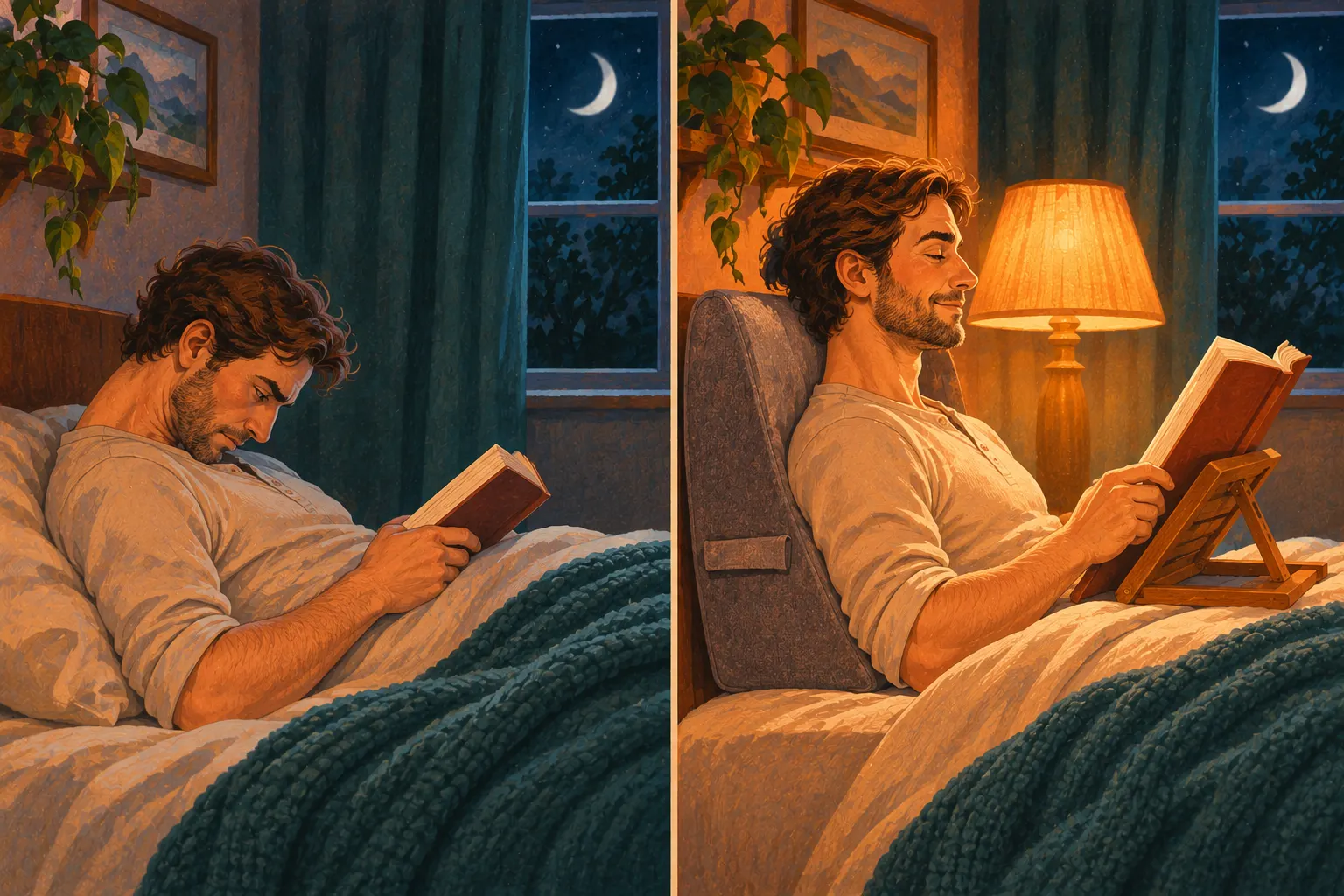
The further your head tips forward, the greater the load on your neck. A 2014 computer model (Hansraj) shows the scale: a head held upright means about 5 kg for the cervical spine, while one tilted 60 degrees means about 27 kg. These are one author's calculations, not measurements, but they show well why reading with your chin on your chest tires your neck.
| Head tilt | Load on the neck (model) |
|---|---|
| 0° (upright) | about 5 kg |
| 15° | about 12 kg |
| 30° | about 18 kg |
| 45° | about 22 kg |
| 60° | about 27 kg |
- Sit half upright with your back supported. A wedge or a pillow with arms holds your back, and your elbows have something to rest on.
- Raise the book, don't lower your head. A book stand for reading in bed or a pillow on your lap lifts the book closer to eye level.
- On your side: an e-reader is lighter than a thick book and easier to prop on a stand; switch sides every now and then.
- On your back with the book above your face: your arms tire quickly, and a heavy book can fall on your face. Best kept short.
This advice is common sense, not research findings: I didn't find reliable studies comparing reading pillows. If your neck hurts all the time, not just after reading, it's worth seeing a physiotherapist.
Reading pillow, book light and eye drops: what's worth having
Nobody paid me for these suggestions. The links lead to an Amazon search and are affiliate links: if you buy something, BookRank may earn a small commission, and you don't pay any more. Choose the exact model yourself, after reading the description and what it's made of.
- Reading wedge pillowGood for: sitting half upright in bedA triangular wedge supports your back at a fixed angle. Choose a height that suits your bed and your height.See on Amazon →
- Reading pillow with armsGood for: long reading sessions, support for your elbowsA backrest with “arms” like an armchair: your elbows don't hang, and the book sits higher.See on Amazon →
- Book stand for reading in bedGood for: neck and armsHolds a book or e-reader closer to eye level, so your arms can rest.See on Amazon →
- Clip-on book light, warm lightGood for: reading next to someone who's asleepLook for adjustable brightness and a warm (amber) tone for the evening.See on Amazon →
- Preservative-free artificial tearsGood for: dry eyes in the eveningLubricating drops in single-use vials. Read the leaflet before use; if you wear contact lenses, check they're approved for them.See on Amazon →
- Kindle PaperwhiteGood for: reading in the evening without a lampAn e-ink reader with an adjustable warm light (Amazon confirms this on the product page).See on Amazon →
When to see a doctor about your eyes
Eye strain after reading goes away after a rest. It's worth seeing an eye doctor if:
- your eyes are dry or sting every day despite drops and breaks,
- your vision is blurred even after a rest, or you've started seeing double,
- you hold the book further and further away to read the print (it may be time for reading glasses),
- your eye is red and painful, light hurts, your vision has suddenly got worse, you've injured your eye, there's a pus-like discharge, or a red eye appears while you wear contact lenses: then see a doctor straight away, and go to the emergency department if you also have a severe headache with nausea.
- you're over 40: a routine eye check is worth having even without any symptoms.
Sources
- American Academy of Ophthalmology (AAO): pages on eye myths, eye strain, dry eye, eye drops, blue light and myopia in children.
- Mayo Clinic: eyestrain (2024) and dry eyes.
- Harvard Health Publishing: blue light and sleep.
- Chang et al., PNAS 2015: reading on an iPad and sleep (12 people).
- Benedetto et al., 2013: eye fatigue with e-ink, LCD and paper (12 people).
- Chu et al., 2014: blinking on screen and on paper (25 people).
- Talens-Estarelles et al., 2023: the 20-20-20 rule (29 people).
- Huang et al., 2015: close-up work and short-sightedness (meta-analysis).
- Cochrane: artificial tears (2016, 43 studies) and blue-light filtering glasses (2023, 17 studies).
- Hansraj, 2014: load on the cervical spine when the head is tilted (model).
What to read in the evening?
If you're looking for a book for the evening, take a look at the ranking of the best books, the new releases or the book finder that matches your mood.
Questions and answers
Does reading in the dark damage your eyes?
No. According to the American Academy of Ophthalmology, reading in dim light doesn't damage your eyes, it just tires them faster. The fatigue goes away after a rest.
Is reading on a Kindle at night worse for your eyes than a book?
In a 2013 study, an e-ink reader tired the eyes as much as paper. A tablet with an LCD screen was more tiring. A bright tablet before bed can also delay falling asleep.
What are the best eye drops for tired eyes?
Lubricating drops, also called artificial tears. Preservative-free ones can be used more often; those with preservatives up to about 4 times a day. Better to skip “redness relief” drops.
How do you read in bed without hurting your neck?
Sit half upright with your back supported (a wedge or a pillow with arms) and raise the book closer to eye level instead of bending your head.
What is the best light for reading before bed?
Warm light, aimed at the page from behind or from the side, without glare. A warm, dimmed tone interferes less with falling asleep than a cold white one.
Do blue-light glasses help?
The American Academy of Ophthalmology doesn't recommend them, and a 2023 Cochrane review concluded that they may not reduce eye strain.