#18 in Economics
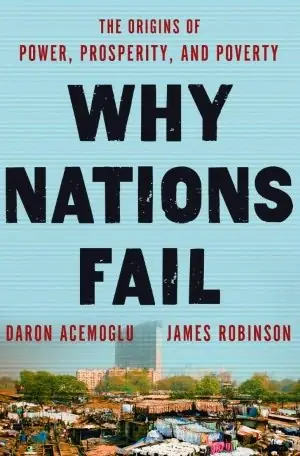
Why Nations Fail
- 529
- Pages
- about 10 h
- Reading time
- NYT bestseller · 1 week on the list
Affiliate link: buying through it supports BookRank at no extra cost to you.

Our view
“Why Nations Fail” argues one idea with great persistence: institutions, not climate, geography or culture, decide whether a country prospers. Acemoglu and Robinson rest the case on historical examples from ancient Rome to present-day China and set it out clearly. Some find the cases picked to fit a conclusion reached in advance, with rival explanations brushed aside, and some think the years since 2012 have dated it.
The view of the BookRank editors, written from readers’ ratings and comments. It does not affect the score or the book’s place in a ranking.
About the book
Shortlisted for the Financial Times and Goldman Sachs Business Book of the Year Award 2012.Why are some nations more prosperous than others? Why Nations Fail sets out to answer this question, with a compelling and elegantly argued new theory: that it is not down to climate, geography or culture, but because of institutions. Drawing on an extraordinary range of contemporary and historical examples, from ancient Rome through the Tudors to modern-day China, leading academics Daron Acemoglu and James A. Robinson show that to invest and prosper, people need to know that if they work hard, they can make money and actually keep it - and this means sound institutions that allow virtuous circles of innovation, expansion and peace.Based on fifteen years of research, and answering the competing arguments of authors ranging from Max Weber to Jeffrey Sachs and Jared Diamond, Acemoglu and Robinson step boldly into the territory of Francis Fukuyama and Ian Morris. They blend economics, politics, history and current affairs to provide a new, powerful and persuasive way of understanding wealth and poverty.
Where the score comes from
The sources average 7.7 across 226 ratings — not yet many, so the reader vote carries 61% of the weight and the rest pulls toward the Economics average of 7.8. That is how 7.8 comes out.
| Source | Average | Ratings | Weight |
|---|---|---|---|
| Open Library | 7.4 | 34 | 15% |
| Hardcover | 7.8 | 192 | 85% |
Frequently asked
How long is Why Nations Fail?
It has 529 pages — longer than 85% of the ranked books in Economics.
In this book
Themes this book shares with others — each leads to the best books on it.
If you liked this
Same shelf — Economics — with scores between 7.7 and 7.8, closest to this book.