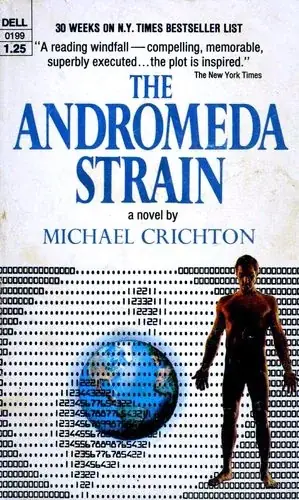
The Andromeda Strain
- 295
- Pages
- about 5 h
- Reading time
- Film 1971 +1
- On screen
- Seiun Award for Best Translated Long Work
Affiliate link: buying through it supports BookRank at no extra cost to you.
Our view
Crichton frames this story as the official report of a secret government project, complete with computer-style graphics of test results, and the device works: the scientists’ hunt for a deadly microorganism feels documented, not invented. Readers who like their tension built from procedure and science are held almost to the end. Some find the resolution so abrupt that they feel cheated of a proper finish.
The view of the BookRank editors, written from readers’ ratings and comments. It does not affect the score or the book’s place in a ranking.
About the book
The Andromeda Strain is a 1969 novel by American writer Michael Crichton, his first novel under his own name and his sixth novel overall. It documents the outbreak of a deadly extraterrestrial microorganism in Arizona and the team of scientists investigating it. The book is presented as a report from a secret government project involving scientists, and features text-based computer imagery that illustrates the results of various tests on the organism. The Andromeda Strain appeared in The New York Times Best Seller list, establishing Michael Crichton as a genre writer, and is an early example of the techno-thriller genre.
On screen
This book has been adapted for the screen 2 times — from 1971 to 2008.
Adaptation data: Wikidata · On screen →
Where the score comes from
The sources average 7.5 across 853 ratings. With that many, the reader vote carries 85% of the weight and the score stays at 7.5 — the Classics average of 7.7 barely moves it.
| Source | Average | Ratings | Weight |
|---|---|---|---|
| Open Library | 8.0 | 10 | 1% |
| Google Books | 8.0 | 17 | 2% |
| Hardcover | 7.4 | 826 | 97% |
Frequently asked
How long is The Andromeda Strain?
It has 295 pages — shorter than 81% of the ranked books in Classics.
In this book
Themes this book shares with others — each leads to the best books on it.
If you liked this
Same shelf — Classics — with scores between 7.4 and 7.6, closest to this book.