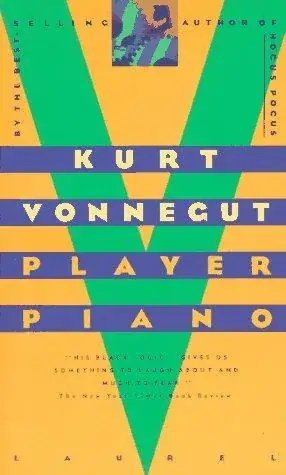
Player Piano
- 317
- Pages
- about 6 h
- Reading time
Affiliate link: buying through it supports BookRank at no extra cost to you.
Our view
Vonnegut’s 1952 debut “Player Piano” imagines a society that automates its workers out of a purpose, and it reads as a very current book. Engineers and managers run a mechanised country in which everyone the machines replaced has nothing left to do. Some readers who know his later books find this vision less interesting. Others note that the novel offers no cure, only an account of how such a world could come about.
The view of the BookRank editors, written from readers’ ratings and comments. It does not affect the score or the book’s place in a ranking.
About the book
Player Piano is the debut novel by American writer Kurt Vonnegut Jr., published in 1952. The novel depicts a dystopia of automation partly inspired by the author's time working at General Electric, describing the negative impact technology can have on quality of life. The story takes place in a near-future society that is almost totally mechanized, eliminating the need for human laborers. The widespread mechanization creates conflict between the wealthy upper class, the engineers and managers, who keep society running, and the lower class, whose skills and purpose in society have been replaced by machines. The book uses irony and sentimentality, which were to become hallmarks developed further in Vonnegut's later works.
Where the score comes from
The sources average 7.5 across 285 ratings — not yet many, so the reader vote carries 66% of the weight and the rest pulls toward the Classics average of 7.7. That is how 7.6 comes out.
| Source | Average | Ratings | Weight |
|---|---|---|---|
| Open Library | 7.5 | 29 | 10% |
| Hardcover | 7.4 | 256 | 90% |
Frequently asked
How long is Player Piano?
It has 317 pages — shorter than 77% of the ranked books in Classics.
In this book
Themes this book shares with others — each leads to the best books on it.
If you liked this
Same shelf — Classics — with scores between 7.5 and 7.6, closest to this book.