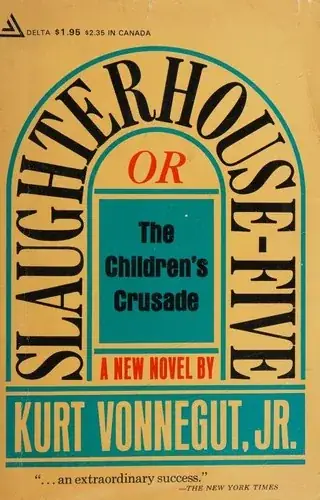
Slaughterhouse-Five
- 205
- Pages
- about 4 h
- Reading time
- Film 1972
- On screen
- 20th Century's Greatest Hits: 100 English-Language Books of Fiction
- NPR Top 100 Science Fiction and Fantasy Books
Affiliate link: buying through it supports BookRank at no extra cost to you.

Our view
Part war novel, part science fiction, part dark comedy, and deliberately none of them entirely. Vonnegut tells the bombing of Dresden through a man who keeps slipping through time, and the abrupt changes of tone are how the book makes its horror felt. Some readers finish it moved without quite knowing why, and others find the war chapters hard to follow. Short and strange, it suits those who can accept a broken chronology.
Worth knowing Vonnegut was a prisoner of war in Dresden and survived the Allied firebombing of February 1945 in an underground meat locker of the slaughterhouse that gives the book its name. It took him more than twenty years to write about it, and the first chapter, in his own voice, explains why. The phrase “So it goes” follows every death in the book, about a hundred times. George Roy Hill filmed it in 1972.
The view of the BookRank editors, written from readers’ ratings and comments. It does not affect the score or the book’s place in a ranking.
About the book
Slaughterhouse-Five, or, The Children's Crusade: A Duty-Dance with Death is a 1969 semi-autobiographic science fiction–infused anti-war novel by Kurt Vonnegut. It follows the life experiences of Billy Pilgrim, from his early years, to his time as an American soldier and chaplain's assistant during World War II, to the post-war years. Throughout the novel, Billy frequently travels back and forth through time. The protagonist deals with a temporal crisis as a result of his post-war psychological trauma. The text centers on Billy's capture by the German Army and his survival of the Allied firebombing of Dresden as a prisoner of war, an experience that Vonnegut endured as an American serviceman. The work has been called an example of "unmatched moral clarity" and "one of the most enduring anti-war novels of all time". The book has been translated into at least 11 other languages including German (twice), Italian (twice), French, Polish, Portuguese,Bulgarian, and Chinese.
On screen
This book has been adapted for the screen once.
- FilmSlaughterhouse-FiveIMDb
Adaptation data: Wikidata · On screen →
Where the score comes from
The sources average 8.2 across 3,535 ratings. With that many, the reader vote carries 96% of the weight and the score stays at 8.2 — the Rankings average of 8.0 barely moves it.
| Source | Average | Ratings | Weight |
|---|---|---|---|
| Open Library | 8.3 | 258 | 7% |
| Hardcover | 8.2 | 3.3K | 93% |
In this book
Themes this book shares with others — each leads to the best books on it.