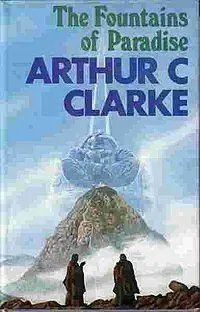
The Fountains of Paradise
- 261
- Pages
- about 5 h
- Reading time
- Hugo Award for Best Novel
- Nebula Award for Best Novel
Affiliate link: buying through it supports BookRank at no extra cost to you.
Our view
The hero of “The Fountains of Paradise” is an idea, the space elevator, and Clarke makes its construction a calm celebration of human ambition. Short chapters move between times, places and viewpoints, and readers often praise the prose. Some miss memorable characters and plot twists, and others feel the thread about religion fades out halfway. It is science fiction for people who want the engineering to be the story.
The view of the BookRank editors, written from readers’ ratings and comments. It does not affect the score or the book’s place in a ranking.
About the book
The Fountains of Paradise is a 1979 science fiction novel by British writer Arthur C. Clarke. Set in the 22nd century, it describes the construction of a space elevator. This "orbital tower" is a giant structure rising from the ground and linking with a satellite in geostationary orbit at the height of approximately 36,000 kilometres. Such a structure would be used to raise payloads to orbit without the expense of using rockets. The novel won both the Hugo and Nebula Awards for Best Novel.
Where the score comes from
The sources average 7.6 across 148 ratings — not yet many, so the reader vote carries 50% of the weight and the rest pulls toward the Science fiction average of 7.8. That is how 7.9 comes out. A further +0.20 comes from the small bonus for major awards.
| Source | Average | Ratings | Weight |
|---|---|---|---|
| Open Library | 7.9 | 23 | 16% |
| Hardcover | 7.5 | 125 | 85% |
Frequently asked
How long is The Fountains of Paradise?
It has 261 pages — shorter than 84% of the ranked books in Science fiction.
In this book
Themes this book shares with others — each leads to the best books on it.
If you liked this
Same shelf — Science fiction — with scores between 7.8 and 7.9, closest to this book.