#1 in Economics
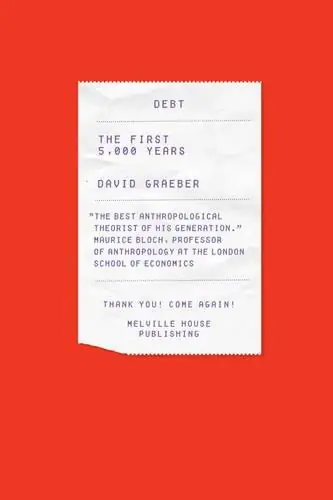
Debt
- 544
- Pages
- about 10 h
- Reading time
Affiliate link: buying through it supports BookRank at no extra cost to you.

Our view
“Debt” retells five thousand years of economic history through the question of who owes what to whom, and that sweep is its great strength. Graeber, an anthropologist and a gifted storyteller, disputes the familiar idea that money grew out of barter. Some readers lose the argument among digressions, and some think his conclusions outrun the evidence; critics have also pointed to inaccuracies.
The view of the BookRank editors, written from readers’ ratings and comments. It does not affect the score or the book’s place in a ranking.
About the book
Debt: The First 5,000 Years is a book by anthropologist David Graeber published in 2011. It explores the historical relationship of debt with social institutions such as barter, marriage, friendship, slavery, law, religion, war and government. It draws on the history and anthropology of a number of civilizations, large and small, from the first known records of debt from Sumer in 3500 BCE until the present. Reception of the book was mixed, with praise for Graeber's sweeping scope from earliest recorded history to the present; others criticized Debt for its inaccuracies.
Where the score comes from
The sources average 8.5 across 236 ratings — not yet many, so the reader vote carries 61% of the weight and the rest pulls toward the Economics average of 7.8. That is how 8.3 comes out.
| Source | Average | Ratings | Weight |
|---|---|---|---|
| Open Library | 9.1 | 45 | 19% |
| Hardcover | 8.4 | 191 | 81% |
Frequently asked
How long is Debt?
It has 544 pages — longer than 87% of the ranked books in Economics.
In this book
Themes this book shares with others — each leads to the best books on it.
If you liked this
Same shelf — Economics — with scores between 7.9 and 8.3, closest to this book.