#9 in Psychology
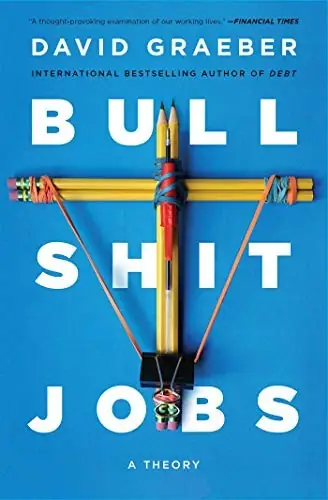
Bullshit Jobs: A Theory
- 416
- Pages
- about 8 h
- Reading time
Affiliate link: buying through it supports BookRank at no extra cost to you.

Our view
David Graeber’s “Bullshit Jobs” gives a name and a theory to something many people sense: jobs that would not be missed if they vanished. He sorts them into five types, from flunkies to box tickers, explains how they arise, and argues that pretending such work matters does psychological harm. The book goes deeper than its title suggests, into why labour is prized at all, and proposes a universal basic income.
The view of the BookRank editors, written from readers’ ratings and comments. It does not affect the score or the book’s place in a ranking.
About the book
Bullshit Jobs: A Theory is a 2018 book by the American anthropologist David Graeber that postulates the existence of meaningless jobs which cause psychological harm. He contends that over half of societal work is pointless and becomes psychologically destructive because workers are required to pretend their role is not as pointless or harmful as they know it to be. Graeber classifies a job as bullshit if society would be no worse off if such job(s) disappeared, and names five classes of meaningless jobs: flunkies, goons, duct tapers, box tickers, and taskmasters. He argues that the association of labor with virtuous suffering is recent in human history and proposes universal basic income as a potential solution which would allow individuals to choose how they would like to contribute to humanity.
Where the score comes from
The sources average 8.1 across 272 ratings — not yet many, so the reader vote carries 65% of the weight and the rest pulls toward the Psychology average of 7.9. That is how 8.2 comes out.
| Source | Average | Ratings | Weight |
|---|---|---|---|
| Open Library | 8.6 | 35 | 13% |
| Hardcover | 8.0 | 237 | 87% |
Frequently asked
How long is Bullshit Jobs: A Theory?
It has 416 pages — longer than 71% of the ranked books in Psychology.
In this book
Themes this book shares with others — each leads to the best books on it.
If you liked this
Same shelf — Psychology — with scores between 8.1 and 8.4, closest to this book.