#43 in Popular science
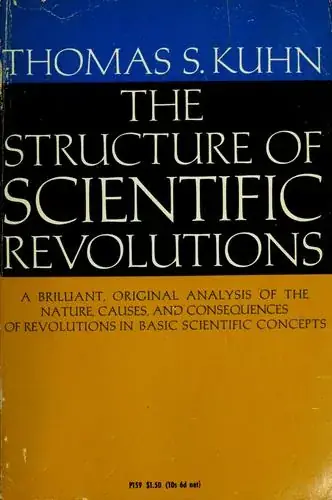
The Structure of Scientific Revolutions
- 210
- Pages
- about 4 h
- Reading time
- John Desmond Bernal Prize
- International Sociological Association Books of the Century
Affiliate link: buying through it supports BookRank at no extra cost to you.

Our view
“The Structure of Scientific Revolutions” remains a landmark account of how science advances, and its central argument still holds attention. Kuhn rejects the picture of knowledge piling up fact by fact: long stretches of “normal science” inside an accepted framework are broken, once anomalies mount, by revolutions that install a new paradigm. At little more than two hundred pages it is compact, and some readers find it within reach of non-specialists.
The view of the BookRank editors, written from readers’ ratings and comments. It does not affect the score or the book’s place in a ranking.
About the book
The Structure of Scientific Revolutions is a 1962 book about the history of science by the philosopher Thomas S. Kuhn. Its publication was a landmark event in the history, philosophy, and sociology of science. Kuhn challenged the then prevailing view of progress in science in which scientific progress was viewed as "development-by-accumulation" of accepted facts and theories. Kuhn argued for an episodic model in which periods of conceptual continuity and cumulative progress, referred to as periods of "normal science", were interrupted by periods of revolutionary science. The discovery of "anomalies" accumulating and precipitating revolutions in science leads to new paradigms. New paradigms then ask new questions of old data, move beyond the mere "puzzle-solving" of the previous paradigm, alter the rules of the game and change the "map" directing new research.
Where the score comes from
The sources average 7.9 across 124 ratings — not yet many, so the reader vote carries 46% of the weight and the rest pulls toward the Popular science average of 8.3. That is how 8.1 comes out.
| Source | Average | Ratings | Weight |
|---|---|---|---|
| Open Library | 8.4 | 26 | 21% |
| Hardcover | 7.8 | 98 | 79% |
Frequently asked
How long is The Structure of Scientific Revolutions?
It has 210 pages — shorter than 85% of the ranked books in Popular science.
If you liked this
Same shelf — Popular science — with scores between 7.9 and 8.1, closest to this book.