#52 in Popular science
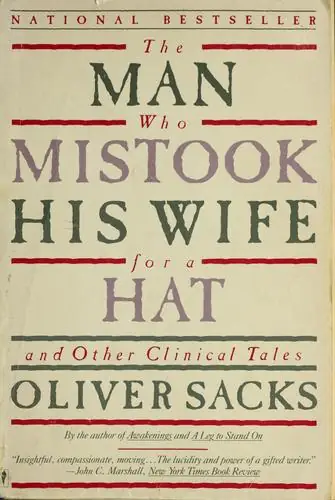
The Man Who Mistook His Wife for a Hat
- 308
- Pages
- about 6 h
- Reading time
Affiliate link: buying through it supports BookRank at no extra cost to you.

Our view
“The Man Who Mistook His Wife for a Hat” turns neurology into strange, absorbing stories that are as much philosophy as medicine. Sacks’s curiosity about what remains of a person when the brain fails is the book’s lasting appeal. Some readers object to the way patients are discussed, and the cases are best taken as storytelling, since parts are now known to be embellished. Technical terms appear, but rarely for long.
The view of the BookRank editors, written from readers’ ratings and comments. It does not affect the score or the book’s place in a ranking.
About the book
The Man Who Mistook His Wife for a Hat and Other Clinical Tales is a 1985 book by neurologist Oliver Sacks presenting narratives based on some of his patients. Sacks chose the title of the book from the case study of one of his patients who has visual agnosia, a neurological condition that leaves him unable to recognize faces and objects. The book became the basis of an opera of the same name by Michael Nyman, which premiered in 1986. While the book is often categorized as nonfiction, Sacks' private journals and correspondences have revealed that he embellished or fabricated some of its content.
Where the score comes from
The sources average 7.9 across 567 ratings — not yet many, so the reader vote carries 79% of the weight and the rest pulls toward the Popular science average of 8.3. That is how 8.0 comes out.
| Source | Average | Ratings | Weight |
|---|---|---|---|
| Open Library | 8.2 | 56 | 10% |
| Hardcover | 7.8 | 511 | 90% |
Frequently asked
How long is The Man Who Mistook His Wife for a Hat?
It has 308 pages — shorter than 60% of the ranked books in Popular science.
In this book
Themes this book shares with others — each leads to the best books on it.
If you liked this
Same shelf — Popular science — with scores between 8.1 and 8.3, closest to this book.