#4 in Business
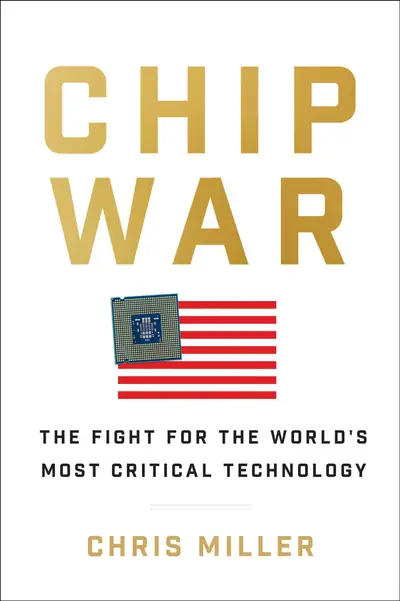
Chip War
Affiliate link: buying through it supports BookRank at no extra cost to you.
About the book
An epic account of the decades-long battle to control what has emerged as the world's most critical resource—microchip technology—with the United States and China increasingly in conflict. You may be surprised to learn that microchips are the new oil—the scarce resource on which the modern world depends. Today, military, economic, and geopolitical power are built on a foundation of computer chips. Virtually everything— from missiles to microwaves, smartphones to the stock market — runs on chips. Until recently, America designed and built the fastest chips and maintained its lead as the #1 superpower. Now, America's edge is slipping, undermined by competitors in Taiwan, Korea, Europe, and, above all, China. Today, as Chip War reveals, China, which spends more money each year importing chips than it spends importing oil, is pouring billions into a chip-building initiative to catch up to the US. At stake is America's military superiority and economic prosperity. Economic historian Chris Miller explains how the semiconductor came to play a critical role in modern life and how the U.S. become dominant in chip design and manufacturing and applied this technology to military systems. America's victory in the Cold War and its global military dominance stems from its ability to harness computing power more effectively than any other power. But here, too, China is catching up, with its chip-building ambitions and military modernization going hand in hand.
Where the score comes from
The sources average 8.8 across 186 ratings — not yet many, so the reader vote carries 56% of the weight and the rest pulls toward the Business average of 7.9. That is how 8.4 comes out.
| Source | Average | Ratings | Weight |
|---|---|---|---|
| Open Library | 10.0 | 5 | 3% |
| Hardcover | 8.7 | 181 | 97% |
In this book
Themes this book shares with others — each leads to the best books on it.
If you liked this
Same shelf — Business — with scores between 8.2 and 8.4, closest to this book.