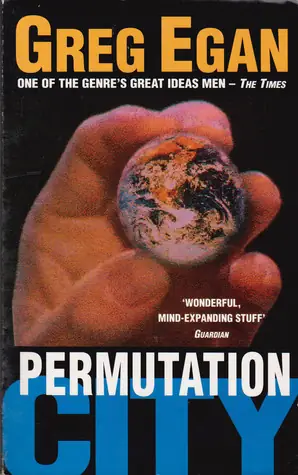
Permutation City
- 340
- Pages
- about 6 h
- Reading time
- John W. Campbell Memorial Award for Best Science Fiction Novel
Affiliate link: buying through it supports BookRank at no extra cost to you.

Our view
“Permutation City” is idea-driven science fiction that follows simulated reality and artificial life to their furthest philosophical conclusions. Greg Egan’s speculation is the reason to pick it up, and even its critics credit the scale of the thinking. Readers less taken with it report little tension, characters hard to tell apart or to like, and dry prose; some find the ending unsatisfying. It suits those who come for the argument more than for the plot.
The view of the BookRank editors, written from readers’ ratings and comments. It does not affect the score or the book’s place in a ranking.
About the book
Permutation City is a 1994 science-fiction novel by Greg Egan that explores many concepts, including quantum ontology, through various philosophical aspects of artificial life and simulated reality. Sections of the story were adapted from Egan's 1992 short story "Dust", which dealt with many of the same philosophical themes. Permutation City won the John W. Campbell Award for the best science-fiction novel of the year in 1995 and was nominated for the Philip K. Dick Award the same year. The novel was also cited in a 2003 Scientific American article on multiverses by Max Tegmark.
Reading order · Subjective Cosmology
Full order & progress →- QuarantineStart here
 7.77.7 / 10
- Permutation CityThis book
 7.97.9 / 10
- DistressDistress–Not ranked yet
Where the score comes from
The sources average 7.9 across 200 ratings — not yet many, so the reader vote carries 58% of the weight and the rest pulls toward the Science fiction average of 7.8. That is how 7.9 comes out.
| Source | Average | Ratings | Weight |
|---|---|---|---|
| Open Library | 7.5 | 22 | 11% |
| Hardcover | 8.0 | 178 | 89% |
Frequently asked
How long is Permutation City?
It has 340 pages — shorter than 72% of the ranked books in Science fiction.
In this book
Themes this book shares with others — each leads to the best books on it.
If you liked this
The same shelf — Science fiction — and a score of 7.9, the closest to this book.