
關於本書
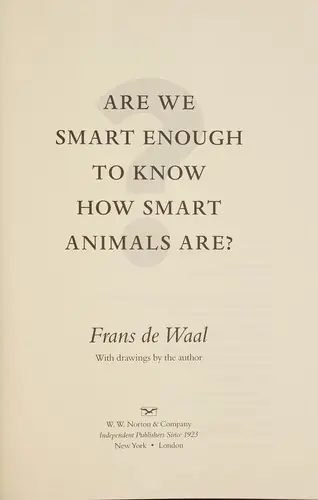
What separates your mind from the mind of an animal? Maybe you think it's your ability to design tools, your sense of self, or your grasp of past and future - all traits that have helped us define ourselves as the pre-eminent species on Earth. But in recent decades, claims of human superiority have been eroded by a revolution in the study of animal cognition. Take the way octopuses use coconut shells as tools, or how elephants can classify humans by age, gender, and language. Take Ayumu, the young male chimpanzee at Kyoto University who demonstrates his species' exceptional photographic memory. Based on research on a range of animals, including crows, dolphins, parrots, sheep, wasps, bats, whales, and, of course, chimpanzees and bonobos, Frans de Waal explores the scope and depth of animal intelligence, revealing how we have grossly underestimated non-human brains. He overturns the view of animals as stimulus-response beings and opens our eyes to their complex and intricate minds. With astonishing stories of animal cognition, Are We Smart Enough to Know How Smart Animals Are? challenges everything you thought you knew about animal - and human - intelligence.
分數的組成
各來源在 62 則評分上的均值是 7.9。數量還不多,讀者票只占權重的 30%,其餘被拉向自然與環境的均值 8.1。8.1 就是這麼來的。
| 來源 | 平均 | 評分數 | 權重 |
|---|---|---|---|
| Open Library | 8.3 | 8 | 13% |
| Hardcover | 7.9 | 54 | 87% |
常見問題
《Are We Smart Enough to Know How Smart Animals Are?》有多長?
共 352 頁,比自然與環境榜上 50% 的書更長。
本書主題
這本書與其他書共有的主題,點擊可查看該主題的佳作。
喜歡這本的話
同在自然與環境書架,分數介於 7.8 與 8.7 之間,與本書最接近的作品。