
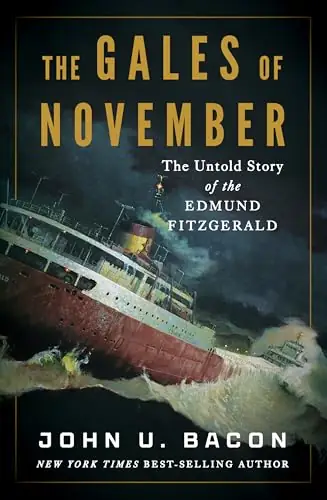
The Gales of November
- 490
- Stron
- ok. 9 godz.
- Czas czytania
- Bestseller NYT · 11 tygodni na liście, najwyżej 3. miejsce
Link partnerski: kupując przez niego, wspierasz BookRank. Cena się nie zmienia.
O książce
10 Best History Books of 2025 Bookpage • Best Books of 2025 "A work of spectral beauty destined to be a classic. Readers of Sebastian Junger’s The Perfect Storm, Erik Larsen’s Dead Wake, and Nathaniel Philbrick’s In the Heart of the Sea will love this deeply reported tale." —Hampton Sides, New York Times best-selling author of The Wide Wide Sea and In the Kingdom of Ice “The Untold Story of the Edmund Fitzgerald’ has been told and retold by authors and bards. But never has it been told better than by Mr. Bacon in this colorful and compelling book.... Dead men tell no tales, but their loved ones do. Mr. Bacon tracked them down and listened.” —John J. Miller, Wall Street Journal On the fiftieth anniversary of the Edmund Fitzgerald’s sinking, the bestselling author of The Great Halifax Explosion tells the definitive story of the “Mighty Fitz.” For three decades following World War II, the Great Lakes overtook Europe as the epicenter of global economic strength. The region was the beating heart of the world economy, possessing all the power and prestige Silicon Valley does today. And no ship represented the apex of the American Century better than the 729-foot-long Edmund Fitzgerald—the biggest, best, and most profitable ship on the Lakes. But on November 10, 1975, as the “storm of the century” threw 100 mile-per-hour winds and 50-foot waves on Lake Superior, the Mighty Fitz found itself at the worst possible place, at the worst possible time.
Skąd bierze się wynik
Średnia ze źródeł to 8,3 z 20 ocen — to jeszcze niewiele, więc głos czytelników waży 12%, a reszta ciągnie w stronę średniej kategorii Rankingi (7,8). Stąd wynik 8,1.
| Źródło | Średnia | Ocen | Waga |
|---|---|---|---|
| Hardcover | 8,3 | 20 | 100% |
Głosy czytelników
Najbardziej lubiane recenzje z Hardcover (CC BY autorzy).
“Well written, researched, and very respectful to the families of the 29 crewmen who went down with the ship. I learned a lot about the history of shipping on the Great Lakes and how a culmination of factors led to an inevitable disaster. Even if…”